Showing posts with label places to go and eat. Show all posts

Tuesday, August 7, 2018

Getting Salty in Point Roberts

Point Roberts
I managed to make it out to Canada’s west coast the same time good friend and writer Nina was visiting with her friend Anne in Ladner. I joined them and we weren’t there long when Margaret, another old friend and voyageur, called us to adventure.

Did we want to cross the border? she asked.

Nina and I shared a knowing glance. Was Margaret referring to that intellectual hinterland that declared an environmental blitzkrieg? Nina asked. She is an ecologist and strong proponent of the environment. Nina also writes eco-fiction and climate fiction. The current rapacious U.S. administration's disrespectful and ill-treatment of the environment has driven her out of principle to boycott that country.

"No," Margaret answered. "Point Roberts."

We exchanged another look; cute off from the rest of the United States, Point Roberts was practically Canadian, given that it was an isolated peninsula off Canada and once even considered seceding from the U.S. to join Canada. Wikipedia describes it as a "pend exclave" of United States, located on the southernmost tip of the Twawwassen Peninsula, south of Vancouver, B.C. 


Seabright Farm Stairs to the ocean
Point Roberts gets its name from Captain Vancouver, who named it after his friend Henry Roberts. It was officially declared part of the United States in 1849, when the Oregon Treaty extended the 49th parallel as the boundary between the U.S. and British territory (which Canada was at the time) from the Rocky Mountains to Georgia Strait.

After thinking it over, we replied, "Sure!" We were eager for adventure, after all. Something that might get our feet wet or us lost then found. Something big ... or small. Something outside then inside...
Boundary Bay community

So, we went on walkabout ... well, drive-about, to be precise. We drove into that sleepy American community of 1300 or so people, looking to discover something or someplace.

After an uneventful border crossing, we drove along Boundary Bay Road through a sleepy community of cottages that faced the bay. From there we drove to Lighthouse Marine Park for a walk along the ocean shore, where we picked up whelks strewn on the pebble beach and watched a purse seining boat put out its net. The day was sunny  but not overly hot. A cool sea breeze brought the smell of brine and seaweed. 


Tamra Hansen, owner and chef
I was soon peckish from the sun and sea air. We retraced out steps to a charming cafe with outdoor patio for lunch and settled on the back patio. Saltwater Cafe has been around for a while; long enough to have plenty of character both inside and outside. The current owner has been there over 17 years. 

We decided on two platters to share: the Wedge and the Charcuterie Plate. Both were exquisitely presented and thoroughly enjoyed over Moscow Mules (Vodka, spicy ginger beer and lime juice) and lively discussion that excluded politics.

Owner and chef Tamra Hansen--also a Canadian--uses local ingredients for the rotating menu based on what's in season. We know, because when Nina entered to get two coffees, we overheard Tamra instructing on of the servers to being in some lavender from their garden (for the Lavender Mojito--one of their signature drinks). That's fresh!

The Saltwater website tells it this way:


Charcuterie Plate
"Located on Gulf Road, in Point Roberts, Saltwater Cafe is the establishment we've longed to create. After starting and operating a large number of successful restaurants both locally and nationally, we decided to settle back in Point Roberts and open something close to our hearts.

"Out menu is inspired by authentic cooking and the diverse flavours of the Pacific Northwest, made utilizing local ingredients gathered by Chef and owner, Tamra Hansen. We have a huge range of rotating specials depending on the season, featuring BBQ, wood fired pizzas, sandwiches and more! In addition to our specials we have tons of delicious cakes, muffins and pastries. Find them all lined up on the bar as you walk in. We also have a 'pick your own' sweet counter, great for kids and big kids alike."

Here's what Nina, Margaret and I had from the menu that day:


Moscow Mule
Moscow Mules: vodka, spicy ginger beer, fresh squeezed lime juice and mulled lime.

Charcuterie Plate: assorted gourmet cheeses and meats, served with nuts, fresh figs and other seasonal fruit with a side of freshly baked bread.

The Wedge: iceberg lettuce wedge, crispy apple with bacon, grape tomatoes, blue cheese crumbles, garlic vinaigrette, blue cheese drizzle and asiago cheese.


part of Saltwater Cafe garden


Cafe is Open:
Tuesday-Sunday, 8pm-4 pm
Monday closed


Contact: 

1345 Gulf Road,
Point Roberts, WA 98281
T: 360-945-7258 (SALT)
E: info@thesaltwatercafe.com


Friday, October 24, 2014

The Lipscani District of Bucharest

Strada Smardan in Lipscani District
Thanks to my Romanian friend SF writer Nina Munteanu, I found myself flying into Henri Coandă International Airport in Bucharest last week. We came to attend the Gaudeamus Book Fair at Romexpo where Editura Paralela 45 was launching the Romanian version of Nina’s writing guidebook The Fiction Writer (Scriitorul de Fictiune).

Dr. Florin Munteanu, respected scientist in Complexity Theory, picked us up at the airport and took us to the Phoenicia Grand Hotel, a rather posh spacious hotel that lived up to its name. We relaxed in the lounge, discussing fractal geometry and the Fibonacci Golden Ratio over café crèmes. It was a very civilized introduction to this eclectic “city of joy” (bucurie means joy in Romanian) and I felt strangely at home.

Alexander Lobrano of the New York Times heralded Bucharest as “one of the last European cities that hasn’t been pasteurized by gentrification or lost its soul to mass tourism. It’s an odd but lively mutt of a city—one that’s clearly seen better days but where something is also suddenly stirring. The locals love to have a good time, and the Romanian economy is chugging along pretty nicely.” I’m not sure I agree with calling Bucharest a “mutt of a city”; although Bucharest does exude eccentricity in style and form, spanning the baroque to neo-gothic style of the Lipscani District to the eclectic opulence of the CEC Bank building to the insane self-indulgent extravagance of Ceauşescu’s Casa Popurului (House of the People). Parisianne-inspired Arcul de Triumf and the Odean Theatre are reasons why Bucharest is sometimes referred to as Little Paris of the East. The historic Lipscani District in Old Town Bucharest (in the heart of the city), provides an authentic medieval setting — complete with pedestrian cobbled lanes — that includes stunning baroque, renaissance and neo-classical architecture dating back to medieval times. It is all that remains of a previously vibrant commercial centre (much of which was destroyed during Ceauşescu’s reign).

Long before the official founding of the city of Bucharest in 1459, the Lipscani area was already an important commercial centre. It got its name from the German town of Leipzig, because during the 1600s and 1700s many traders from Leipzig came to sell their wares to the locals and the Turks. Lipscani flourished in the 1600s after Vlad Tepes (the Turk impaler) chose it for his Princely Court. Craftsmen and merchants from all over settled there and many of Lipscani’s streets still retain the names of these trades. The diverse mix of Romanian, Greek, Bulgarian, Serbian, Armenian, Jewish, Albanian and Austrians mingled and clashed in a vibrant mix of culture and contrast.

The general decay of the historic centre following successive bombings by the Allies and the Luftwaffe during World War II, then a devastating earthquake in 1977, rendered it vulnerable to communist leader Nicolae Ceauşescu's maniacal vision of a concrete, communist Utopia. Ceauşescu ordered Bucharest's historic centre demolished to make way for his Civic Centre project, which included the massive Palace of Parliament, and replaced a section of the historic district larger than New York's Central Park with unimaginative grotesque imitations of palatial elegance. Somehow, the Lipscani District managed to survive to see the 1989 Romanian Revolution and Ceausescu's execution.

George Kudor, one of Dr. Munteanu’s brilliant students, took me to the Lipsani District where we wandered the pedestrian cobbled streets, along Strada. Smardan, the first street to be completely repaved and renovated, past sushi bars, shops, Irish pubs, nightclubs and cafes like the Dutch-owned Grand Café Van Gogh, which according to Lobrano serves awesome coffee. 
  
I found us wandering down Stavropoleos Street. George led me to an old monastery built in the Brâncovenesc style where he said he often came to listen to the Byzantine music of the small choir. The church holds the largest collection of Byzantine music books in Romania. Built in 1724, the Stavropoleos monastery was dedicated to St. Archangels Michael and Gabriel. The name Stavropoleos is a Romanian rendition of a Greek word (Stauropolis), which means “the city of the Cross”.

Caru cu Bere on Str. Stavropoleos
We continued down Str. Stavropoleos with a view of the CEC Palace Romanian Savings Bank, an eclectic building with a monumental central dome and entrance archway supported by pillars. We walked along neo-gothic facades to one of Lipscani’s best known and popular restaurants, Caru’ cu Bere (cart of beer), which brews its own beer in a stunning Bell Epoque cathedral-like setting of high vaulted ceilings with painted ceilings, balconies, chandeliers, stained glass, and frescoes and ornate woodwork. One patron from London remarked, “It was like having a meal at Cardiff Castle!” The decadently opulent neo-gothic interior was designed by the Austrian architect Zigrid Kofczinsky in 1875 as a beer hall (they certainly had interesting ideas of what a beer hall should look like then!). The service has apparently vastly improved from its former Sovietsky days. Our waitress was friendly and prompt. Caru’ cu Bere has a menu the size of a newspaper and celebrates a diversity of traditional Romanian food like mamaliga (polenta-like dish), carnaţi şi fasole (sausage and beans), dovlecei umpluţi cu carne (squash stuffed with minced meat), varzǎ acrǎ cǎlitǎ cu cǎrnaţi bine afumaţi (sauerkraut with smoked sausage) and sarmale (cabbage rolls) to a juicy T-bone steak. The banner outside the restaurant proclaims in English: “Possibly the Best Restaurant in Town.” For its combination of atmosphere, good local food and price, they might be right.

Neo-gothic interior of Caru cu Bere
George then took me through the Macca-Villacrosse Passage, an odd little U-shaped passageway linking Streets Lipscani and Eugen Carada with Calea Victoriei. This jewel of 19th century architecture is a year-round haven for coffee drinkers and shoppers beneath amber-tinted glass roof. Named “Valley of the Kings”, the passage was renovated in 1989 and contains small stores, a bistro, Chinese restaurant and cafes. Among them is the Cafenea Egipleana, an Egyptian-themed café and hookah lounge, where patrons share shisha or flavored tobacco from a communal hookah or nargile, placed at each table.

After meeting Dr. Munteanu at the Centre for Complexity on Jean-Louis Calderan, we walked to Burebista Vanatoresc (Str. Batistei) a local medieval-themed restaurant where we enjoyed another hearty traditional Romanian meal (Romanians like to eat—my kind of people!) to the piano music of a local artist. I saw dishes like carnati de oaie (mutton sausages) and mititei (grilled links of mixed ground meat seasoned with garlic, thyme and anise). Specialties include bear paws and civet; spicy crispy pork ribs, filet of wild boar in red wine and brandy sauce. I had ciorbă de perişoare (meatball soup), which came with hearty bread and a bracing Romanian beer. 

Macca-Villacrosse Passage
Bucharest is Europe’s sixth largest city and a three-hour flight from most western European capitals, adds Lobrano. I saw obvious influences of western (particularly North American) consumerism and pop culture (e.g., apparel, modern architecture, fast-food places like KFC, Pizza Hut; English spoken everywhere)—no doubt a visceral reaction of a culture emerging from the oppressive Ceauşescu reign. I also recognized the influence of the east in the foods, dress, Byzantine architecture, music and comportment of the locals. 

Florin Munteanu said it perfectly: “Romania is the corpus callosum of the world,” where east and west converge, mingle and learn. It’s no wonder that Romania is one of the leading countries in work on complexity theory, a science that embraces the “collision” of different “worlds” to create more than the sum of its parts. I look forward to coming back to this vibrant city and its countryside. When I return I will make sure to visit Bucharest’s excellent museums, particularly the Muzeul Taranului Roman (Peasant Museum) and the Muzeul Naţional al Satului Diminitrie Gusti (Village Museum). Both are not far from the Lipscani District.


Monday, July 8, 2013

Keeping Louisville Weird: Ramsi’s Café on the World

Entrance to Patio of Ramsi's Cafe on the World
It was midnight and I was feeling right frisky. My whippet friend Sparky was fast asleep in his doggy bed. This wasn't Paris at midnight, but Louisville Kentucky harbours a magical place. Bardstown Road, in the historic Highlands is like Paris -- it never shuts down. Bardstown's funky nature adds additional sparkle to this magic hour.

Leaving Sparky to his dreams of bones and chasing cats, I scampered off, looking for adventure.

Picture that image of the world with cutouts of people from all races, sex, color and age standing on top and you have an idea of Ramsi’s Café on the World. Situated in one of the funkiest parts of one of the funkiest streets in Louisville, Kentucky—Bardstown Road— Ramsi’s is definitely on top of the world. “If America is truly the melting pot of the globe,” said reviewer Jessica Elliott, “then Ramsi's Café on the World should be our national eatery.” The restaurant features late hours and a menu of international foods that includes a sampling of every sort of cuisine imaginable— 103 different items, I’m told.

Manni with Toulouse and our waitress
When  I got there shortly after midnight, they were still hopping with customers: a diverse and eclectic mix of diners, forming a boiling pot of cultures stirred into a fun cocktail of lively discussion and laughter over great food and drink.

My new friend Manni would explain that this is because Ramsi’s has something for everyone. Owner Ramsi, a native of Jerusalem, is an engineer by trade but his love for food and his vision for a
multicultural meeting place with affordable food for everyone translated into a café with incredible ambience.

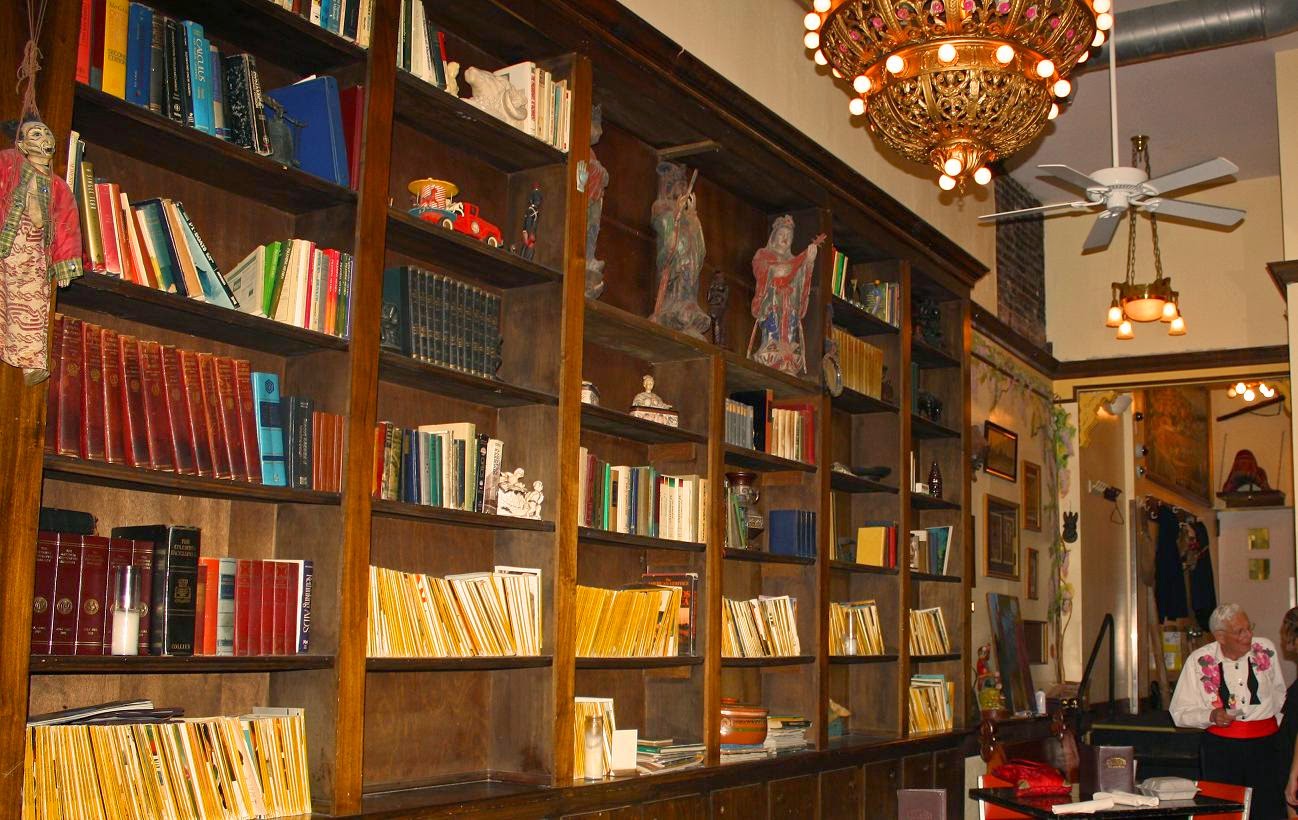
The café offers a richly visual interior decorated with an eclectic mixture of fine art, sculptures, bookshelves and artifacts from all over the world.  My friend Snoopf said that the inside looked as though “a team of National Geographic photographers and world explorers had a day off and decided they would try out interior design.” The café also provides a classic European-style courtyard garden, complete with large overhanging plants, sculptures and a trickling fountain.

Interior of Ramsi's Cafe
After seating me in the garden patio, the waitress suggested Ramsi’s evening finger-food platter—a kind of antipasto— and I agreed, realizing that I felt quite peckish after my long walk in the Highlands.

While I waited for the food, I ordered a Ginger Pear Martini. My first sip surprised me with midnight sunshine and my whiskers trembled. This elegant yet zesty cocktail tasted of “summer love”. Made with fresh pear and ginger and Grey Goose La Poire vodka, it scintillated like an exquisite aria.  I shall have to make this drink for a good friend, I thought to myself.

I leaned back and enjoyed the frisson of sipping an elegant drink in a cultured setting. My whiskers Cavalleria Rusticana, when a distinguished looking gentleman approached me with a curious smile. No doubt, he recognized a classy cat when he saw one. He introduced himself as Manni the Magician in a pleasant NYC drawl. I invited him to join me and he happily took the seat opposite me. Manni explained to me that Ramsi had hired him to do magic tricks weekend evenings to entertain the crowd that packed his café pretty most every evening. Manni came to Louisville from New York in 1972. Using typical NYC vernacular, Manni told me about Ramsi’s. “You can go to anyone on the street,” Manni said to me, “and touch them on the shoulder and say, ‘do you know where Ramsi’s is?’ and they will say ‘that’s my favorite restaurant!’ ”
Bar at Ramsi's Cafe on the World
quivered as I hummed Mascagni’s
Manni  reiterated my observation in his New York way: “Ramsi’s attracts every color, every income, every ethnicity, and every hairdo…”

I curbed a saucy grin and ran my paw briskly through my unruly fur coat.

The platter arrived and I devoured with gusto a variety of color, texture and taste with complex aroma. I helped myself alternatively to banana peppers, tomato and cucumber relish, feta, portabella mushrooms, roasted red peppers, falafel, calamata olives with baba ganoush and humus.

Manni watches Toulouse devouring
Despite my invitation to join in, Manni just watched me devour the assorted treats and talked. He informed me that Ramsi’s wife, Rhona, is a graduate of the University of Kentucky and involved in every aspect of the restaurant, particularly menu development. Ramsi’s twin brother Ramzi , who’s been involved with the restaurant since its inception, also helps with quality control in the kitchen as their head chef.

Ramsi's Cafe on the World is one of the most unique and likely one of the most vegan-friendly establishments in Louisville. Some of the more popular dishes include the roasted vegetable Panini-portabellow mushrooms, roasted red peppers, yellow squash and red onions topped with crispy fried onions served on homemade Cuban bread. Try pairing this with a mojito or Ramsi's signature island Cooler to complete the vegan experience.  

Ramsi’s is located fortuitously right next to Carmichael’s Bookstore. Why is this fortuitous?
According to writer Jessica Elliott, this lets you browse there as you wait for a table—the only
Sparky with his favourite chewing toy...
downside of Ramsi’s is it takes a while to get a table sometimes. Manni confided that some patrons come often enough to merit their own table place tags.

Aside from its elegant tree-lined residences (like the one Sparky lives in), the Highlands is best known for three things: its eccentric stores, its funky bars, and its diverse selection of restaurants and cafés. Many of the very best restaurants can be found on Bardstown Road, like Avalon, the Bristol Bar & Grill, Kashmir Indian Restaurant, Le Gallo Rosso and Palermo Viejo. What makes Ramsi's Cafe on the World unique is that its menu features not just one type of cuisine; it features popular dishes from all over the world. And the clientele to go along with it.

1293 Bardstown Rd
Louisville, Kentucky 40204
Phone Number: (502) 451-0700
Website: ramsiscafe.com